
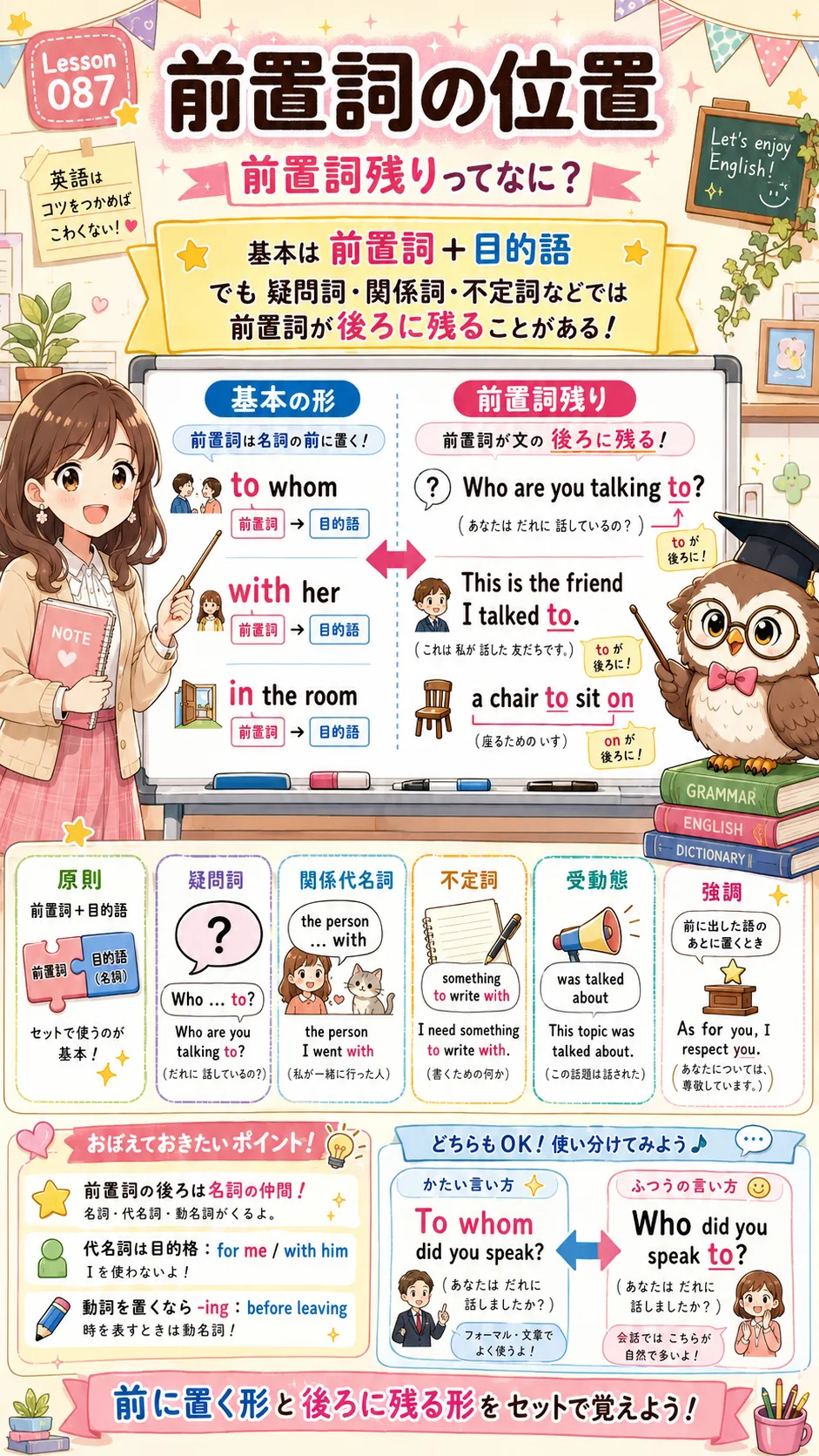
前置詞の位置(前置詞残り)とは?
前置詞は、基本的には
「前置詞+名詞・代名詞」
のように、名詞や代名詞の前に置きます。
ただし、疑問詞・関係代名詞・to不定詞などが関わると、
前置詞が文の後ろ側に残る形があります😊
このページでは、
「前に置く形」と「後ろに残る形」
を比べながら、自然な英語の語順をやさしく整理します。
▮ 目次
✅ 迷ったら 「1 → 2 → 3 → 4 → 5 → 6 → 総まとめ」 の順がおすすめです。
📱 スマホでも見やすいように、章ごとにカード形式で整理しています。
-
1. 前置詞の位置(まずは原則) 最初にここ基本は
前置詞+目的語。まずは「前置詞は何の前に置くのか」を確認します。 -
2. 疑問詞が目的語になるとき 会話で重要「だれに」「何について」などをたずねるとき、前置詞が後ろに残る形を整理します。
-
3. 関係代名詞が目的語になるとき
which/whom/thatと前置詞の位置を比べて、フォーマル度の違いも見ます。 -
4. 不定詞句が名詞を修飾するパターン
名詞+to不定詞+前置詞の形で、前置詞が後ろに残る考え方をつかみます。 -
5. 群動詞の受動態で主語が目的語になるとき群動詞を受動態にしたとき、前置詞や副詞が文の後ろ側に残るパターンを学びます。
-
6. 強調で目的語を文頭へ強調したい語句を前に出したとき、前置詞が後ろに残る文の流れを確認します。
-
🧾 総まとめ:前置詞の位置と前置詞残りの使い分け 迷ったらここ「前に置く形」「後ろに残る形」「フォーマルな形」をまとめて確認します。
-
📝 Lesson087 まとめクイズ — 前置詞の位置(前置詞残り)とは? 理解度チェックLesson087 全体の内容をクイズで総復習します。前置詞を前に置く形・後ろに残る形・強調表現までまとめて確認しましょう。
1. 前置詞の位置(まずは原則)
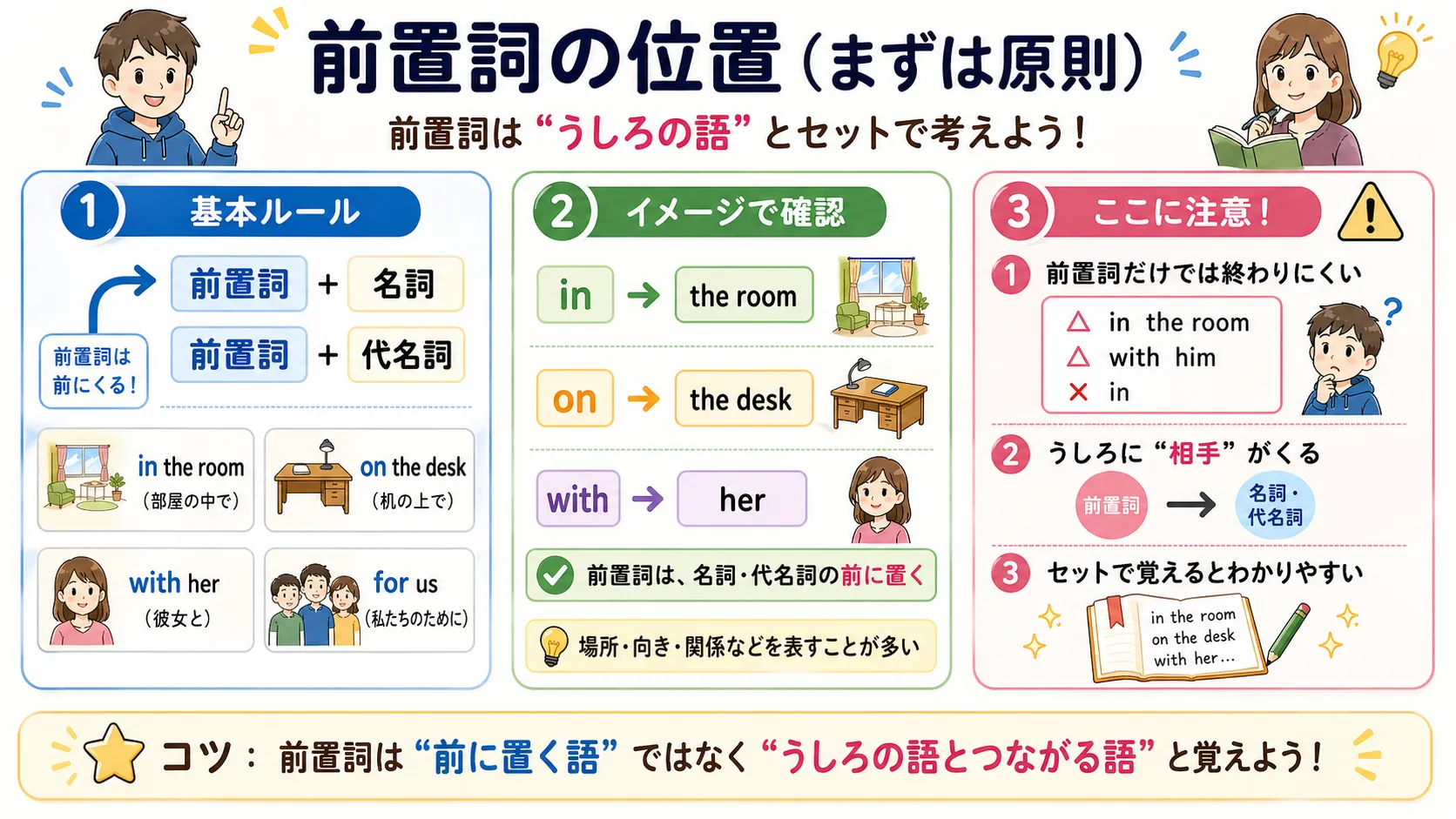
前置詞は、名前のとおり
名詞・代名詞などの前に置くことば
です。
いちばん大切な形は、
前置詞 + 目的語
です😊
ここでいう目的語とは、前置詞の後ろに来て、意味のまとまりを作る語句 のことです。
in the room
at the station
on the desk
for me
with them
before leaving
about what happened
in だけ、for だけでは意味が不完全です。
in the bag
のように、後ろに the bag が来て初めて「バッグの中に」という意味になります。
前置詞の後ろに代名詞を置くときは、
me / him / her / us / them
のような目的格を使います。
× for I
ではなく、
○ for me
です。
-ing
前置詞の後ろには「名詞の仲間」が来ます。
そのため、動詞を置きたいときは
動名詞(-ing)
にします。
例:× without say
→ ○ without saying
⚠️ よくあるミス(前置詞のあとを見れば直せる!)
between you and I✅ between you and me
前置詞
between の後ろなので、I ではなく me。
before leave✅ before leaving
前置詞の後ろで動作を表すなら、動名詞
-ing にします。
to を全部同じと思う
go to school:前置詞 to✅
want to learn:不定詞の to後ろが名詞か、動詞の原形かで見分けます。
📌 前置詞の後ろに来るもの:基本パターンまとめ
| 型 | 代表語・代表表現(日本語訳) | 使い方のイメージ | 注意点 |
|---|---|---|---|
名詞句前置詞 + 名詞
|
in the kitchen(台所で)at the front desk(受付で)on the top shelf(一番上の棚に)under the blanket(毛布の下に)near the exit(出口の近くに)during the break(休憩中に)
|
場所・時間・位置関係を表す、いちばん基本の形です。 場所 時間 方向 |
in は「中・範囲」、at は「点」、on は「接触」の感覚から始めると整理しやすいです。
|
代名詞前置詞 + 目的格
|
for me(私のために)with him(彼と一緒に)next to her(彼女の隣に)from us(私たちから)about them(彼らについて)between you and me(あなたと私の間で)
|
人・相手・対象を表します。 前置詞の後ろでは、代名詞は目的格になります。 |
× for I / × with he ○ for me / ○ with him |
動名詞前置詞 + -ing
|
before leaving(出発する前に)after finishing work(仕事を終えたあとで)without asking(尋ねずに)by checking the list(リストを確認することで)for helping me(私を助けてくれて)instead of waiting(待つ代わりに)
|
動作を「名詞のようなかたまり」にして、前置詞の後ろに置きます。 |
前置詞の後ろに動詞を置くなら原形ではなく -ing。× without ask → ○ without asking |
wh節前置詞 + wh節
|
about what happened(何が起きたかについて)from where I stood(私が立っていた場所から)with what we have(私たちが持っているもので)by what she said(彼女が言ったことによって)after what happened yesterday(昨日起きたことのあとで)
|
what や where などを含む文のかたまりが、前置詞の目的語になります。
|
what happened 全体で「起きたこと」という名詞のかたまりです。
|
whether節前置詞 + whether節
|
about whether we should go(行くべきかどうかについて)on whether it is safe(それが安全かどうかに関して)depending on whether he comes(彼が来るかどうかによって)regardless of whether it rains(雨が降るかどうかに関係なく)
|
「〜かどうか」という内容を、前置詞の後ろに置きます。 |
前置詞の後ろでは、原則 if より whether が自然です。
|
注意型to の見分け
|
to the office(会社へ)to my parents(両親へ)to learn English(英語を学ぶために)to meet the client(顧客に会うために)go home(家に帰る)
|
to + 名詞 は前置詞。to + 動詞の原形 は不定詞。
|
home は副詞的に使われるため、× go to home ではなく ○ go home。
|
前置詞 + 名詞
in the kitchen(台所で)at the front desk(受付で)on the top shelf(一番上の棚に)near the exit(出口の近くに)
前置詞 + 目的格
for me(私のために)with him(彼と一緒に)next to her(彼女の隣に)between you and me(あなたと私の間で)
I / he ではなく、me / him。
前置詞 + -ing
before leaving(出発する前に)without asking(尋ねずに)by checking the list(リストを確認することで)instead of waiting(待つ代わりに)
-ing にする。
前置詞 + wh節
about what happened(何が起きたかについて)from where I stood(私が立っていた場所から)with what we have(私たちが持っているもので)
what happened 全体で「起きたこと」。
前置詞 + whether節
about whether we should go(行くべきかどうかについて)depending on whether he comes(彼が来るかどうかによって)regardless of whether it rains(雨が降るかどうかに関係なく)
if より whether が基本。
to の見分け
to the office(会社へ)=前置詞to learn English(英語を学ぶために)=不定詞go home(家に帰る)=to 不要
💬 例文で感覚をつかもう!(前置詞の位置)
The receipt is in my wallet.
(そのレシートは私の財布の中にあります。)
🔧 構造:in + my wallet。前置詞 in の後ろに名詞句 my wallet が来ています。
✅ in は「中に入っている」イメージ。財布・箱・部屋など、境界のある場所と相性が良いです。
🧠 receipt は「レシート」。日常会話でもよく使われます。
Please wait at the main entrance.
(正面入口で待っていてください。)
🔧 at the main entrance は「正面入口という地点で」という意味です。
✅ at は、地図上のピンのように「点」として場所を見るときによく使います。
⚠️ in the entrance だと「入口の中」という内側感が強くなり、待ち合わせ場所としては at が自然です。
We talked about the new schedule.
(私たちは新しい予定について話しました。)
🔧 about + the new schedule で「新しい予定について」。
✅ talk about ... は「〜について話す」の定番表現です。
💡 about の後ろには、名詞だけでなく what happened のような文のかたまりも置けます。
I sent the file to them this morning.
(私は今朝、そのファイルを彼らに送りました。)
🔧 to them は「彼らへ」。前置詞 to の後ろに目的格 them が来ています。
✅ send A to B は「AをBへ送る」。メール・資料共有でよく使います。
⚠️ × to they ではなく ○ to them。
She solved the problem without asking for help.
(彼女は助けを求めずに、その問題を解決しました。)
🔧 without + asking。前置詞 without の後ろなので、動詞は ask ではなく asking。
✅ ask for help は「助けを求める」。for help も前置詞句です。
⚠️ × without ask → ○ without asking
These seats are for guests.
(これらの席はお客様用です。)
🔧 for guests は「お客様のための/お客様用の」。
✅ for は「目的・用途・受け手」を表すときによく使います。
💡 for children(子ども向け)、for beginners(初心者向け)も同じ感覚です。
He arrived at the office before eight.
(彼は8時前に会社に到着しました。)
🔧 at the office は「会社に/会社で」、before eight は「8時前に」。
✅ 1文の中に前置詞句を複数入れて、場所と時間を足すことができます。
⚠️ arrive to the office ではなく、地点なら arrive at ... が基本です。
The cat jumped onto the sofa.
(その猫はソファの上へ飛び乗りました。)
🔧 onto the sofa は「ソファの上へ」。onto は「上への移動」を表します。
✅ on the sofa は「ソファの上にいる」という位置、onto the sofa は「上へ移動する」という動き。
🧠 jump onto ... は「〜へ飛び乗る」の自然な表現です。
I’m interested in learning web design.
(私はWebデザインを学ぶことに興味があります。)
🔧 be interested in ... は「〜に興味がある」。in の後ろなので learning になります。
✅ interested in learning は、学習・趣味・仕事の話でよく使える表現です。
⚠️ × interested in learn → ○ interested in learning
- ✅ 前置詞は、基本的に 名詞・代名詞・動名詞・名詞節の前 に置く。
- ✅ 代名詞は
me / him / her / us / themのような 目的格 にする。 - ✅ 前置詞の後ろに動詞を置きたいときは、原形ではなく
-ingにする。 - 📌 この原則がわかると、次の「疑問詞で前置詞が後ろに残る形」も理解しやすくなります。
2. 疑問詞が目的語になるとき
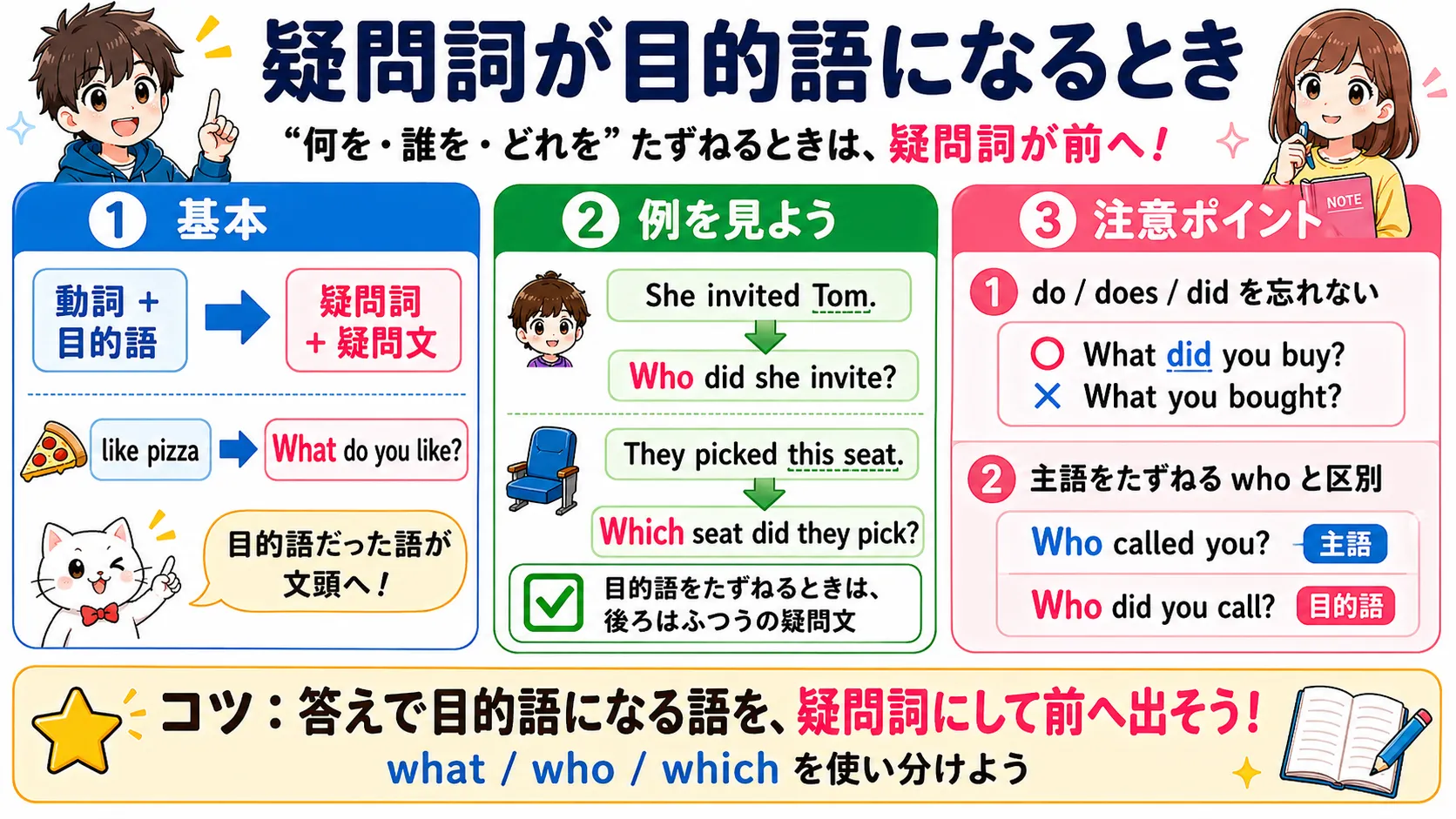
疑問文では、Who / What / Which / Where
などの疑問詞が文の前に出ます。
でも、その疑問詞が本来は
前置詞の目的語
だった場合、会話では前置詞が文の後ろに残ることがよくあります😊
つまり、疑問詞は前へ、前置詞は文末へ という形です。
for what → What ... for?
to who → Who ... to?
about what → What ... about?
from where → Where ... from?
❌
What are you looking?✅
What are you looking for?「何を探しているの?」の
for は、意味を完成させる大事な前置詞です。
もとの考え方は look for what ですが、疑問文では
what
が文の前に出ます。
その結果、
What are you looking for?
のように、for が文末に残ります。
Who did you talk to?
のような形は、日常会話でとても自然です。
一方で、
To whom did you talk?
はかなりフォーマルで、会話では少しかたい響きになります。
talk だけなら「話す」ですが、talk about なら「〜について話す」、
talk to なら「〜に話しかける」です。
つまり、前置詞まで含めて1つの意味
になる表現では、文末の前置詞を忘れないことが大切です。
⚠️ よくあるミス(文末の前置詞を見落とさない)
What are you waiting?✅ What are you waiting for?
wait for ... で「〜を待つ」です。
Who you are talking to?✅ Who are you talking to?
疑問文なので
are you の語順にします。
Who did you send it to?✅ フォーマル:
To whom did you send it?ふだんの会話では文末に前置詞を置く形でOKです。
📌 疑問詞+文末前置詞の基本パターン
| 型 | 代表語・代表表現(日本語訳) | 基本形 | 使い方・注意点 |
|---|---|---|---|
WhatWhat ... 前置詞?
|
look for(〜を探す)talk about(〜について話す)think about(〜について考える)wait for(〜を待つ)pay for(〜の代金を払う)be interested in(〜に興味がある)
|
会話
What are you looking for?直訳感 何を探しているの? |
what が前に出ても、for / about / in などは文末に残ります。前置詞を落とすと意味が途中で止まります。 |
WhoWho ... 前置詞?
|
talk to(〜に話しかける)work with(〜と一緒に働く)sit next to(〜の隣に座る)send ... to(〜へ送る)borrow ... from(〜から借りる)be proud of(〜を誇りに思う)
|
会話
Who did you send it to?意味 それを誰に送りましたか? |
会話では who が自然。とてもフォーマルにすると To whom did you send it? になります。
|
WhichWhich + 名詞 ... 前置詞?
|
put ... on(〜を上に置く)save ... in(〜に保存する)choose from(〜から選ぶ)belong to(〜に所属する)reply to(〜に返信する)focus on(〜に集中する)
|
会話
Which folder did you save it in?意味 どのフォルダに保存しましたか? |
which は「どの〜」なので、後ろに名詞を置くことが多いです。Which shelf ... on? なども自然です。
|
WhereWhere ... from?
|
come from(〜出身である/〜から来る)be from(〜出身である)start from(〜から始まる)move from(〜から引っ越す)return from(〜から戻る)
|
会話
Where are you from?意味 どちらの出身ですか? |
from where も文法的には可能ですが、会話では Where ... from? が自然です。
|
句動詞系動詞 + 前置詞
|
look at(〜を見る)listen to(〜を聞く)deal with(〜に対処する)take care of(〜の世話をする)run into(〜に偶然会う)get over(〜を乗り越える)
|
会話
What are you listening to?意味 何を聞いているの? |
動詞と前置詞がセットで意味を作るため、文末の前置詞を忘れないようにします。 |
フォーマル前置詞 + whom/which
|
to whom(誰に)with whom(誰と)for whom(誰のために)about which(どれについて)in which(その中で)from which(そこから)
|
フォーマル
To whom did you speak?会話 Who did you speak to?
|
書き言葉・かなり丁寧な文では、前置詞を前に出す形もあります。 日常会話では文末前置詞のほうが自然です。 |
What ... 前置詞?
look for(〜を探す)talk about(〜について話す)wait for(〜を待つ)be interested in(〜に興味がある)
What are you looking for?
Who ... 前置詞?
talk to(〜に話しかける)work with(〜と一緒に働く)send ... to(〜へ送る)borrow ... from(〜から借りる)
Who did you send it to?
Which + 名詞 ... 前置詞?
put ... on(〜を上に置く)save ... in(〜に保存する)choose from(〜から選ぶ)focus on(〜に集中する)
Which folder did you save it in?
Where ... from?
come from(〜出身である/〜から来る)be from(〜出身である)start from(〜から始まる)return from(〜から戻る)
Where are you from?
動詞 + 前置詞
listen to(〜を聞く)deal with(〜に対処する)take care of(〜の世話をする)run into(〜に偶然会う)
前置詞 + whom/which
to whom(誰に)with whom(誰と)about which(どれについて)in which(その中で)
Who did you speak to?📘 フォーマル:
To whom did you speak?
💬 例文で感覚をつかもう!(疑問詞+文末前置詞)
What are you looking for?
(何を探しているのですか。)
🔧 もとの意味のまとまりは look for something(何かを探す)です。
✅ 疑問文では something の部分が what になって文頭へ移動します。
⚠️ × What are you looking? だと for が足りず、「何を探す」の意味が完成しません。
Who were you talking to on the phone?
(電話で誰と話していたのですか。)
🔧 talk to someone で「誰かに話す/誰かと話す」。to が意味を支えています。
✅ 会話では Who ... to? がとても自然です。
📘 かなりフォーマルにすると To whom were you talking? ですが、日常会話では少しかたいです。
What did they talk about during the meeting?
(彼らは会議中に何について話しましたか。)
🔧 talk about ... は「〜について話す」。about が話題を示します。
✅ what は「話題の中身」をたずねています。
⚠️ × What did they talk? だと「何について」の about が抜けています。
Which folder did you save the file in?
(そのファイルをどのフォルダに保存しましたか。)
🔧 save the file in a folder がもとの形です。
✅ Which folder が文頭に出たので、前置詞 in が文末に残っています。
💡 PC・スマホ操作の質問でそのまま使える実用表現です。
Where is your manager from?
(あなたの上司はどちらの出身ですか。)
🔧 be from ... で「〜出身である/〜から来ている」。
✅ where が前に出て、from は文末に残ります。
📌 Where are you from? は定番ですが、人によっては出身を聞かれたくない場合もあるので、場面には少し配慮しましょう。
What are you listening to these days?
(最近、何を聞いていますか。)
🔧 listen to ... で「〜を聞く」。英語では to が必要です。
✅ these days は「最近」。音楽・ポッドキャスト・英語学習の話題で使いやすい表現です。
⚠️ × What are you listening? ではなく、○ What are you listening to?
Who will you work with on this project?
(このプロジェクトでは誰と一緒に働く予定ですか。)
🔧 work with someone で「誰かと一緒に働く」。
✅ who が文頭に出て、with は文末に残ります。
💡 on this project は「このプロジェクトで」。文末前置詞とは別の前置詞句として情報を足しています。
What is this button for?
(このボタンは何のためのものですか。)
🔧 be for ... は「〜のためのものだ/〜用だ」という意味です。
✅ What is this for? は「これは何に使うの?」という超定番表現です。
📌 機械・アプリ・道具の使い方を聞くときに便利です。
To whom should I send the invoice?
(請求書はどなたに送ればよいでしょうか。)
🔧 これは前置詞を前に出したフォーマルな形です。to + whom で「誰に」。
✅ ビジネス文書やかなり丁寧なメールでは自然に使えることがあります。
💬 会話では Who should I send the invoice to? のほうがやわらかく自然です。
- ✅ 疑問詞が前置詞の目的語になると、会話では 前置詞が文末に残る ことが多い。
- ✅
What are you looking for?のように、前置詞まで含めて意味が完成する。 - ⚠️
look for / talk about / listen to / work withなどは、前置詞を落とさない。 - 📘
To whom ...?のように前置詞を前に出す形は、かなりフォーマルな言い方。
What are you looking for? のように、疑問詞が前に出ても文末の前置詞を忘れずに使えるかな?
「疑問詞は前へ、前置詞は文末へ」の形をクイズで確認してみよう 😊
3. 関係代名詞が目的語になるとき
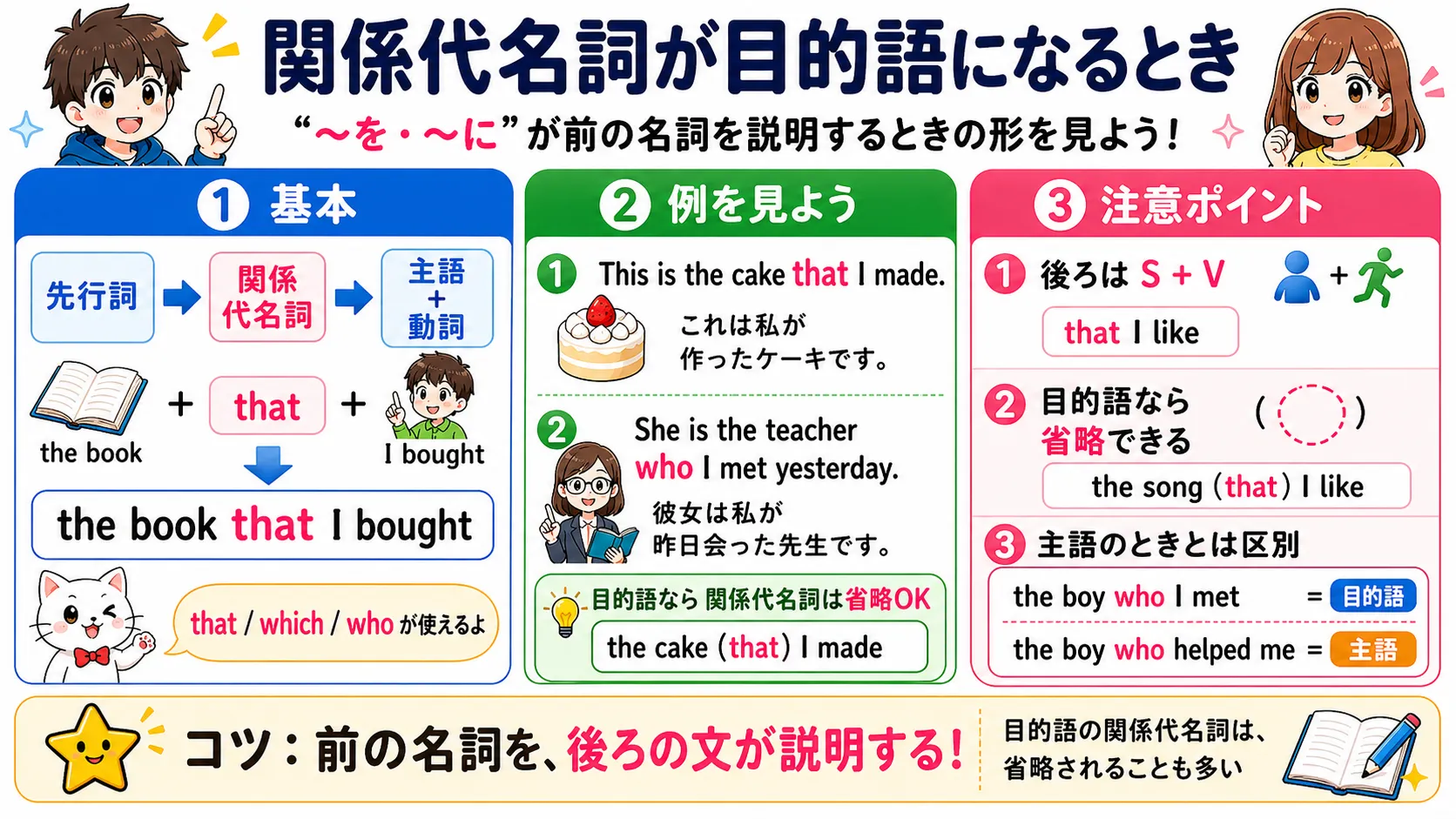
関係代名詞が 前置詞の目的語 になるときも、
Section 2 の疑問詞と同じように、前置詞が後ろに残る形 がよく使われます 😊
たとえば、I spoke to the woman. をもとにすると、
the woman who I spoke to
のように言えます。
そして、よりフォーマルに言うと、
the woman to whom I spoke
の形にもできます。
the person who I spoke to
the book which I asked for
the room that she went into
the colleague I work with
ただし、前置詞を前に出すなら
whom / which
を使い、
that や
省略 はできません。
the person who I talked to
のような形は、とても自然です。
日常会話では
who / which / that
や、場合によっては
関係代名詞の省略
もよく使います。
書き言葉やややかたい文では、
the person to whom I spoke
や
the topic about which we argued
のように、前置詞を前へ出すことがあります。
このときは
関係代名詞を省略できません。
that は前置詞の直後に置けない
たとえば、
× the person to that I spoke
は NG です。
前置詞の直後に置けるのは、基本的に
whom / which
です。
つまり、
○ the person to whom I spoke
/
○ the topic about which we talked
のようにします。
⚠️ よくあるミス(ここを直すとかなり自然!)
the friend who I was waiting✅ the friend who I was waiting for
wait for ... なので for が必要です。
the person to I spoke✅ the person to whom I spoke
前置詞を前に出したら、
whom / which が必要です。
that を前置詞の後ろに置く
the company for that I work✅ the company that I work for
✅ the company for which I work
📌 関係代名詞が前置詞の目的語になるパターンまとめ
| 分類 | 代表語・代表表現(日本語訳) | 基本形・言い換え | ポイント |
|---|---|---|---|
人who ... 前置詞
|
the person who I spoke to(私が話しかけた人)the colleague who I work with(私が一緒に働く同僚)the friend who I waited for(私が待っていた友だち)the customer who I replied to(私が返信したお客様)
|
会話
who + S + V + 前置詞
|
人を表す先行詞で、日常会話ではとても自然です。whom より who が使われやすいです。
|
人that / 省略
|
the person that I spoke to(私が話しかけた人)the partner that she agreed with(彼女が賛成した相手)the intern I sat next to(私が隣に座ったインターン)the client we wrote to(私たちが手紙を書いた顧客)
|
カジュアル
that / 省略 も可
|
目的語なので関係代名詞を省略できます。 ただし、前置詞は文末に残したままにします。 |
物・事which ... 前置詞
|
the topic which we talked about(私たちが話し合った話題)the app which many users rely on(多くの利用者が頼っているアプリ)the issue which they argued over(彼らが言い争った問題)the chair which no one sat on(誰も座らなかった椅子)
|
基本
which + S + V + 前置詞
|
物や内容を表すときの基本形です。 会話では that や省略もよく使います。
|
物・事that / 省略
|
the file that I asked for(私が求めたファイル)the movie that we talked about(私たちが話した映画)the cafe I told you about(私があなたに話したカフェ)the apartment she moved into(彼女が引っ越した部屋)
|
会話で頻出
that / 省略
|
かなり自然な日常英語です。 前置詞は文末に残るので、文の流れがやわらかくなります。 |
フォーマル前置詞 + whom
|
the person to whom I spoke(私が話しかけた人)the colleague with whom she collaborated(彼女が協力した同僚)the customer to whom we replied(私たちが返信したお客様)the friend for whom he waited(彼が待っていた友人)
|
書き言葉
前置詞 + whom
|
人を表すフォーマル表現です。 会話ではややかたい印象になります。 |
フォーマル前置詞 + which
|
the topic about which we argued(私たちが議論した話題)the system on which the service depends(そのサービスが依存するシステム)the room in which they met(彼らが会った部屋)the rule under which we operate(私たちが運用している規則)
|
書き言葉
前置詞 + which
|
物・事を表すフォーマル形です。 レポート・契約書・説明文で見かけやすいです。 |
NG注意that / 省略
|
× the person to that I spoke(誤)× the topic about that we talked(誤)× the person to I wrote(誤)× the file in I saved it(誤)
|
禁止
前置詞の直後に that / 省略 は不可
|
前置詞を前に出すなら、必ず whom / which を使います。ここがいちばんの注意点です。 |
the person who I spoke to(私が話しかけた人)the colleague who I work with(私が一緒に働く同僚)the customer who I replied to(私が返信したお客様)📌 会話ではとても自然です。
the person that I spoke to(私が話しかけた人)the client we wrote to(私たちが手紙を書いた顧客)the intern I sat next to(私が隣に座ったインターン)📌 目的語なので省略もできます。
the topic which we talked about(私たちが話し合った話題)the app which many users rely on(多くの利用者が頼っているアプリ)the issue which they argued over(彼らが言い争った問題)📌 物や内容を表す基本形です。
the file that I asked for(私が求めたファイル)the movie that we talked about(私たちが話した映画)the apartment she moved into(彼女が引っ越した部屋)📌 会話ではかなりよく使います。
the person to whom I spoke(私が話しかけた人)the colleague with whom she collaborated(彼女が協力した同僚)the customer to whom we replied(私たちが返信したお客様)📘 人を表すフォーマル形です。
the topic about which we argued(私たちが議論した話題)the room in which they met(彼らが会った部屋)the rule under which we operate(私たちが運用している規則)📘 物・事を表すフォーマル形です。
× the person to that I spoke× the topic about that we talked× the person to I wrote📌 前置詞を前に出すなら
whom / which を使います。
💬 例文で感覚をつかもう!(関係代名詞が目的語になるとき)
This is the colleague who I work with every Friday.
(こちらが、私が毎週金曜日に一緒に働いている同僚です。)
🔧 もとの形は I work with the colleague です。with の目的語だった the colleague を先行詞にしています。
✅ 会話では who I work with が自然です。
💡 人を表すので who が使われていますが、会話では that にしたり省略したりすることもできます。
She’s the neighbor that I often talk to in the elevator.
(彼女は、私がエレベーターでよく話す近所の人です。)
🔧 talk to someone の someone が先行詞 the neighbor になっています。
✅ この that は目的語なので省略でき、She’s the neighbor I often talk to ... とも言えます。
📌 to を落とすと不自然になるので注意です。
The website which many students rely on is easy to use.
(多くの学生が頼りにしているそのサイトは使いやすいです。)
🔧 rely on ... は「〜に頼る」。on を含めて1つのまとまりです。
✅ 先行詞が物なので which を使っています。
💡 会話では the website that many students rely on や the website many students rely on もよく使います。
That’s the issue that we argued about for hours.
(それが、私たちが何時間も議論した問題です。)
🔧 argue about ... は「〜について議論する」。about を後ろに残す形です。
✅ that は物・事を表す先行詞にも使えます。
📌 目的語なので that は省略でき、That’s the issue we argued about ... も自然です。
I finally found the cafe I told you about.
(やっと、私があなたに話していたカフェを見つけました。)
🔧 この文では、関係代名詞 which / that が省略されています。
✅ もとの形は the cafe which I told you about です。
💡 目的語の関係代名詞は、会話で省略されることがとても多いです。前置詞 about はそのまま残します。
He is the professor to whom I sent the draft last night.
(彼は、私が昨夜原稿を送った教授です。)
🔧 これは send the draft to the professor をもとにしたフォーマルな言い方です。
✅ 前置詞を前に出しているので、whom を使っています。
📘 会話なら He is the professor who I sent the draft to. のほうが自然です。
This is the file in which all the survey data is stored.
(これが、すべての調査データが保存されているファイルです。)
🔧 もとの形は all the survey data is stored in the file です。
✅ 前置詞 in を前に出したので、which を使っています。
📌 書き言葉では自然ですが、会話なら This is the file that all the survey data is stored in. はやや重く感じるので、普通は This is the file where all the survey data is stored. など別表現にすることもあります。
The chair that no one wanted to sit on is still in the corner.
(誰も座りたがらなかったその椅子は、まだ隅にあります。)
🔧 sit on a chair の a chair が先行詞になっています。
✅ that を使った自然な日常表現です。
💡 that を省略して The chair no one wanted to sit on ... としてもOKです。
She is the mentor whom I learned a lot from.
(彼女は、私が多くのことを学んだ指導者です。)
🔧 learn from someone の目的語 someone が先行詞になっています。
✅ whom は人の目的格ですが、会話では who や省略のほうが一般的です。
📌 つまり、She is the mentor who I learned a lot from. / She is the mentor I learned a lot from. も自然です。
- ✅ 関係代名詞が前置詞の目的語になるとき、会話では 前置詞を文末に残す形 が自然。
- ✅ 目的語なので、
who / which / thatの代わりに 省略 できることも多い。 - ✅ フォーマルな書き方では
前置詞 + whom / whichを使う。 - ⚠️
thatや関係代名詞の省略は、前置詞の直後では使えない。
the person who I spoke to のように、関係代名詞が前置詞の目的語になる形を正しく作れるかな?
会話でよく使う「前置詞を文末に残す形」と、フォーマルな to whom / about which の違いをクイズで確認してみよう 😊
4. 不定詞句が名詞を修飾するパターン
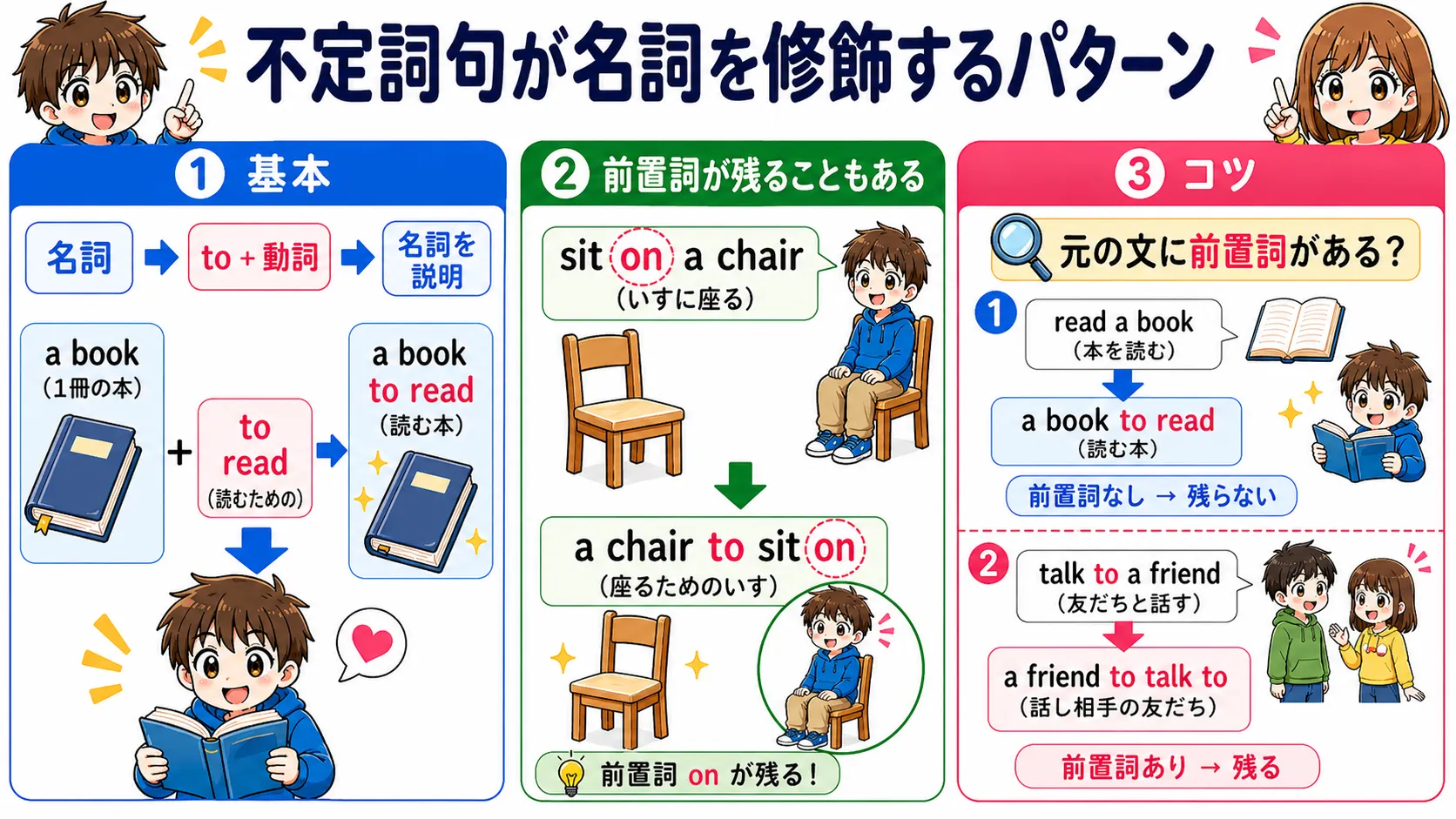
to不定詞 は、名詞の後ろに置いて
「〜するための」「〜すべき」「〜できる」
のように名詞を説明できます。
ただし、その名詞が不定詞句の中で
前置詞の目的語
になる場合、前置詞が後ろに残ります😊
つまり、
名詞 + to + 動詞 + 前置詞
という形です。
a chair to sit on
a pen to write with
a topic to talk about
a room to study in
someone to talk to
✅
a chair to sit on(座るための椅子)❌
a chair to sit英語では普通、
sit on a chair と言うので、on が必要です。
something to drink
は「飲むための何か」、
a place to stay
は「泊まる場所」です。
このように、to不定詞 が名詞の後ろから「どんな名詞か」を説明します。
read a book のように、動詞 read が直接目的語を取れる場合は、
a book to read
でOKです。
一方、sit on a chair のように前置詞が必要な場合は、
a chair to sit on
と前置詞を残します。
write with a pen
だから a pen to write with。
talk about a topic
だから a topic to talk about。
まずは「もとの形」を思い出すと、文末の前置詞が必要かどうか判断しやすくなります。
⚠️ よくあるミス(前置詞を足す?足さない?)
a bed to sleep✅ a bed to sleep in
sleep in a bed なので in が必要です。
a book to read in✅ a book to read
read a book は前置詞なしで目的語を取れます。
to が2つあると混乱する
someone to talk to1つ目の
to は不定詞、最後の to は前置詞です。talk to someone の to が残っています。
sit on a chair → a chair to sit on /
write with a pen → a pen to write with
📌 名詞を修飾する to不定詞+前置詞のパターンまとめ
| 分類 | 代表語・代表表現(日本語訳) | もとの形 | 判断ポイント |
|---|---|---|---|
場所名詞 + to V + in/at/on
|
a room to study in(勉強する部屋)a place to stay at(泊まる場所)a desk to work at(作業する机)a bench to sit on(座るベンチ)a bed to sleep in(寝るベッド)a wall to lean against(寄りかかる壁)
|
study in a roomstay at a placesit on a benchlean against a wall
|
場所を表す名詞が、前置詞の目的語になっています。 in at on against を忘れやすいです。 |
道具名詞 + to V + with
|
a pen to write with(書くためのペン)a knife to cut with(切るためのナイフ)a towel to dry my hands with(手を拭くタオル)a key to open the door with(ドアを開ける鍵)a brush to clean the bottle with(瓶を洗うブラシ)
|
write with a pencut with a knifedry my hands with a towelopen the door with a key
|
「何を使って?」の with が文末に残ります。道具を説明するときにとてもよく使います。 |
相手名詞 + to V + to/with
|
someone to talk to(話し相手)a person to discuss it with(それを相談する相手)a friend to travel with(一緒に旅行する友だち)a teacher to ask questions to(質問する先生)a partner to share ideas with(考えを共有する相手)
|
talk to someonediscuss it with a persontravel with a friendshare ideas with a partner
|
人が「話す相手・一緒にする相手」になる場合です。to と with の使い分けに注意します。
|
話題名詞 + to V + about
|
a topic to talk about(話す話題)something to think about(考えるべきこと)a problem to worry about(心配する問題)a plan to argue about(議論する計画)a question to ask about(質問する内容)
|
talk about a topicthink about somethingworry about a problemargue about a plan
|
「〜について」の about が必要です。× a topic to talk にならないよう注意します。 |
対象名詞 + to V + for/of/on
|
money to live on(生活していくためのお金)a reason to apologize for(謝る理由)nothing to be afraid of(怖がるものは何もない)a rule to depend on(頼る規則)a goal to aim for(目指す目標)
|
live on moneyapologize for a reasonbe afraid of nothingdepend on a ruleaim for a goal
|
動詞・形容詞と前置詞がセットになっている表現です。 まとまりごと覚えると自然に使いやすくなります。 |
前置詞なし名詞 + to V
|
a book to read(読む本)homework to finish(終える宿題)a movie to watch(見る映画)emails to answer(返信するメール)a form to complete(記入する書類)a lesson to review(復習するレッスン)
|
read a bookfinish homeworkwatch a movieanswer emailscomplete a form
|
動詞が直接目的語を取れる場合は、前置詞を足しません。 × a book to read in は不要な前置詞です。 |
名詞 + to V + in/at/on
a room to study in(勉強する部屋)a desk to work at(作業する机)a bench to sit on(座るベンチ)a bed to sleep in(寝るベッド)
名詞 + to V + with
a pen to write with(書くためのペン)a knife to cut with(切るためのナイフ)a towel to dry my hands with(手を拭くタオル)
with が残ります。名詞 + to V + to/with
someone to talk to(話し相手)a friend to travel with(一緒に旅行する友だち)a partner to share ideas with(考えを共有する相手)
名詞 + to V + about
a topic to talk about(話す話題)something to think about(考えるべきこと)a problem to worry about(心配する問題)
about を落とすと意味が足りません。名詞 + to V + for/of/on
money to live on(生活していくためのお金)nothing to be afraid of(怖がるものは何もない)a goal to aim for(目指す目標)
名詞 + to V
a book to read(読む本)homework to finish(終える宿題)emails to answer(返信するメール)
💬 例文で感覚をつかもう!(名詞 + to不定詞 + 前置詞)
I need a quiet bench to sit on.
(座るための静かなベンチが必要です。)
🔧 もとの形は sit on a bench です。a bench が前に出て名詞になり、on が文末に残ります。
✅ a quiet bench to sit on で「座るための静かなベンチ」。
⚠️ a bench to sit だと、英語では「何に座るのか」が不自然に残ります。
Do you have a marker to write with?
(書くためのマーカーを持っていますか。)
🔧 もとの形は write with a marker です。道具を表す with が必要です。
✅ a marker to write with は「それを使って書くマーカー」。
💡 a pen to write with / a pencil to draw with も同じ形です。
She needs someone to talk to after work.
(彼女には仕事の後に話せる相手が必要です。)
🔧 もとの形は talk to someone。to は不定詞の to とは別の前置詞です。
✅ someone to talk to で「話す相手」。とても自然な日常表現です。
📌 to talk with も場面によって使えますが、まずは talk to を基本にすると覚えやすいです。
We still have several issues to talk about.
(私たちには、まだ話し合うべき問題がいくつかあります。)
🔧 もとの形は talk about issues です。話題を表す about が必要です。
✅ issues to talk about は「話し合うべき問題」。会議や相談でよく使えます。
⚠️ issues to talk だと「問題を話す」ではなくなり、不自然です。
This office has a small room to work in when calls are busy.
(このオフィスには、電話が混み合うときに作業できる小さな部屋があります。)
🔧 もとの形は work in a small room。場所の中で作業するので in が必要です。
✅ a small room to work in で「作業するための小さな部屋」。
💡 study in / relax in / wait in なども同じ考え方です。
He saved enough money to live on for three months.
(彼は3か月生活していくためのお金を十分に貯めました。)
🔧 live on money は「お金で生活する/生活していく」。
✅ money to live on で「生活していくためのお金」です。
📌 on は「生活の支えとして頼るもの」を表す感覚で使われています。
I have three lessons to review before the test.
(テスト前に復習するレッスンが3つあります。)
🔧 review lessons のように、review は直接目的語を取れます。
✅ そのため、lessons to review でOK。文末に前置詞はいりません。
⚠️ lessons to review about のように、不要な前置詞を足さないようにしましょう。
We need a tool to open this box with.
(この箱を開けるための道具が必要です。)
🔧 もとの形は open this box with a tool です。道具を表す with が残ります。
✅ a tool to open this box with で「この箱を開けるために使う道具」。
💡 with は「〜を使って」という意味なので、道具系の名詞と相性が良いです。
That project gave us something to be proud of.
(そのプロジェクトは、私たちに誇れるものを与えてくれました。)
🔧 be proud of something で「何かを誇りに思う」。
✅ something to be proud of は「誇れるもの」。英語らしい自然な表現です。
📌 of を落とすと、be proud の対象がなくなって意味が足りません。
- ✅
to不定詞は、名詞の後ろから「〜するための」「〜すべき」と説明できる。 - ✅ もとの形に前置詞があるなら、文末に前置詞を残す。
- ✅
a chair to sit on/a pen to write with/a topic to talk aboutのように考える。 - ⚠️
read a bookのように前置詞なしで目的語を取れる動詞なら、a book to readでOK。
a chair to sit on や a pen to write with のように、
名詞を後ろから説明する to不定詞 の形を正しく作れるかな?
「もとの形に前置詞があるなら、最後に残す」というポイントをクイズで確認してみよう 😊
5. 群動詞の受動態で主語が目的語になるとき
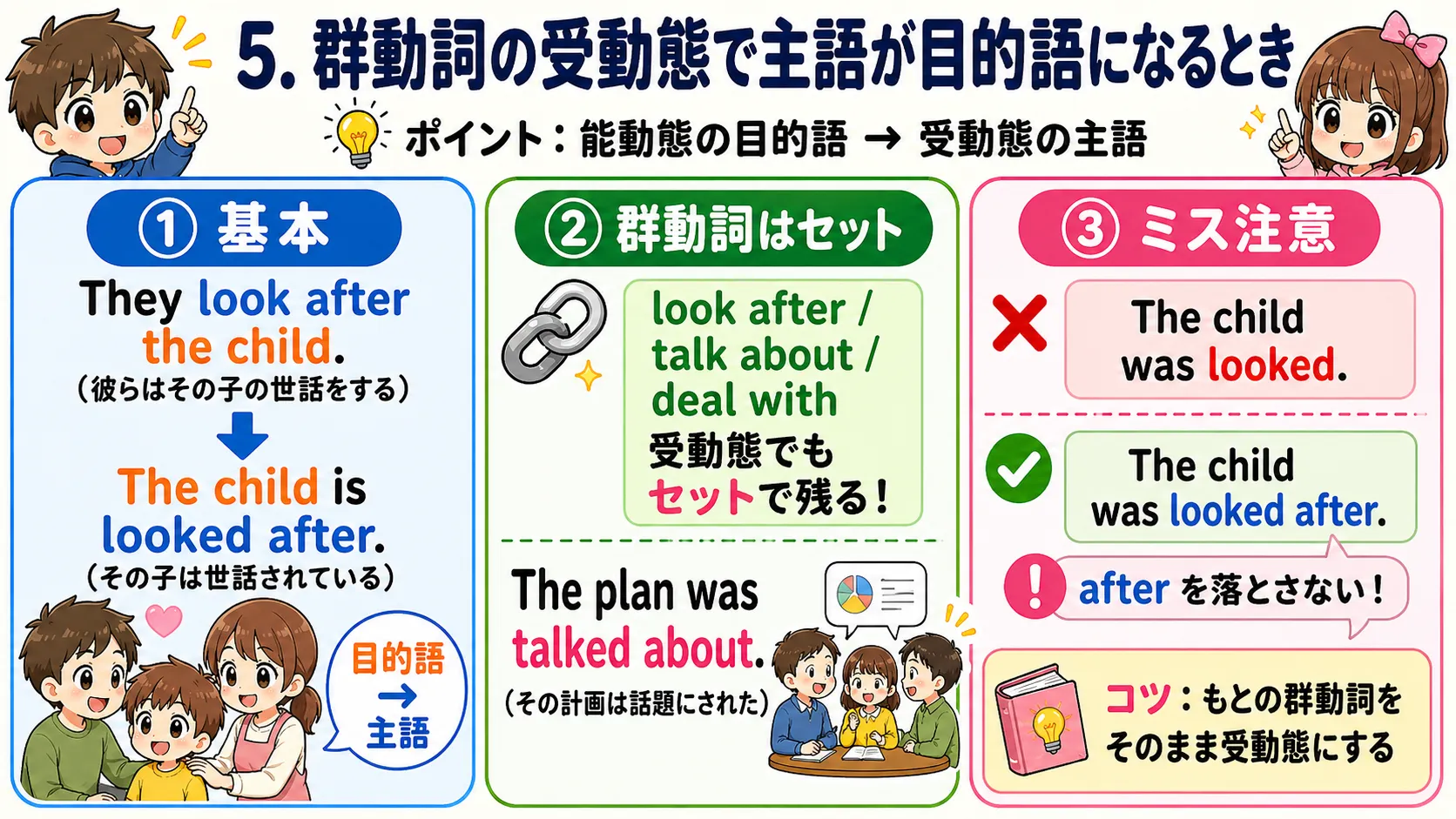
群動詞でも、目的語を取るタイプ なら、
ふつうの動詞と同じように受動態にできます。
そのとき大事なのは、
もとの目的語が主語になる
ことと、
前置詞・副詞を消さない
ことです✨
look after the child
→
The child is looked after.
✅
The child was looked after.❌
The child was looked.after を落としてしまうと、もとの群動詞 look after(世話をする)が壊れてしまいます。
受動態の基本は同じです。
They looked after the baby.
の目的語 the baby が、
The baby was looked after.
の主語になります。
look after、speak to、laugh at、turn down などは、
受動態でも最後の語を残します。
つまり、
be + 過去分詞 + 前置詞 / 副詞
の形になります。
get up(起きる)や go out(外出する)のような
目的語を取らない群動詞
は、ふつう受動態にできません。
まずは「もとの文に目的語があるか」をチェックするとミスが減ります👍
⚠️ よくあるミス(ここを直すとグッと自然!)
The child was looked.✅ The child was looked after.
群動詞は最後までセットです。
*The bed was got up.get up は「起きる」で目的語がないため、普通は受動態にしません。
by ~ を必ず付けると思いこむ
The issue was dealt with immediately.by ~ は、
「だれによって」が大事なときだけ付ければOKです。
📌 群動詞の受動態パターンまとめ
| 分類 | 代表語・代表表現(日本語訳) | 能動態の形 | 受動態の形 | ポイント |
|---|---|---|---|---|
| 世話・対応 |
look after(世話をする)take care of(世話をする)deal with(対処する)look into(調べる)attend to(対応する)
|
look after the childdeal with the problemlook into the case
|
The child is looked after.The problem is dealt with.The case is looked into.
|
世話・問題対応の群動詞は、受動態でもとてもよく使われます。 |
| 会話・言及 |
speak to(話しかける)talk about(〜について話す)refer to(言及する)write about(〜について書く)comment on(〜についてコメントする)
|
speak to the customertalk about the topicrefer to the rule
|
The customer was spoken to.The topic was talked about.The rule was referred to.
|
「〜について」「〜に」を表す前置詞を落とさないことが大切です。 |
| 反応・評価 |
laugh at(〜を笑う)make fun of(〜をからかう)look down on(〜を見下す)pick on(〜をいじめる)stare at(〜をじっと見る)
|
laugh at his jokemake fun of the boylook down on others
|
His joke was laughed at.The boy was made fun of.Others are looked down on.
|
感情・態度を表す群動詞でも受動態がよく使われます。 |
| 副詞型 |
turn down(断る)leave out(省く)carry out(実行する)put off(延期する)throw away(捨てる)
|
turn down the offerleave out a wordcarry out the plan
|
The offer was turned down.A word was left out.The plan was carried out.
|
副詞型でも、最後の副詞を残して受動態にします。 |
| 三語以上の型 |
put up with(我慢する)look forward to(〜を楽しみにする)look down on(〜を見下す)take care of(世話をする)come up with(〜を思いつく)※受動はやや限定的
|
put up with the noiselook forward to the eventtake care of the pets
|
The noise won't be put up with.The event is being looked forward to.The pets are taken care of.
|
長い群動詞でも、セットを崩さないことがポイントです。 |
| 受動不可 |
get up(起きる)go out(外出する)grow up(成長する)show up(現れる)wake up(目が覚める)
|
get up earlygo out at nightgrow up in Tokyo
|
基本的に受動態にしない | 目的語がない群動詞は、ふつう受動態にできません。 |
look after(世話をする)deal with(対処する)look into(調べる)take care of(世話をする)
The child was looked after.✅
The issue was dealt with.
speak to(話しかける)talk about(〜について話す)refer to(言及する)comment on(コメントする)
The topic was talked about.✅
The customer was spoken to.
laugh at(〜を笑う)make fun of(〜をからかう)look down on(〜を見下す)pick on(〜をいじめる)
His joke was laughed at.✅
The boy was made fun of.
turn down(断る)leave out(省く)carry out(実行する)put off(延期する)
The offer was turned down.✅
The meeting was put off.
put up with(我慢する)look forward to(〜を楽しみにする)take care of(世話をする)
The noise won't be put up with.✅
The event is being looked forward to.
get up(起きる)go out(外出する)grow up(成長する)show up(現れる)
💬 例文で感覚をつかもう!(群動詞の受動態)
The children were looked after by their grandparents.
(その子どもたちは祖父母に世話をしてもらいました。)
🔧 能動態は Their grandparents looked after the children. です。
✅ 目的語 the children が主語になり、look after はセットのまま受動態になります。
💡 だれが世話したかを言いたいので、ここでは by their grandparents を付けています。
I was spoken to very politely at the front desk.
(私は受付でとても丁寧に話しかけられました。)
🔧 能動態は Someone spoke to me very politely ... のイメージです。
✅ to を落とさず、was spoken to とします。
📌 受動態にすると「相手より、自分が受けた行為」に焦点が当たります。
The complaint is being dealt with right now.
(その苦情は今まさに対応されています。)
🔧 進行形の受動態なので is being dealt with という形です。
✅ 群動詞でも、時制や形はふつうの受動態と同じように変化できます。
💡 実務でよく使う表現で、担当者がだれか不明でも自然に言えます。
His careless remark was laughed at by some students.
(彼の不注意な発言は、一部の学生に笑われました。)
🔧 能動態は Some students laughed at his careless remark. です。
✅ laugh at の at を落とさないのがポイントです。
⚠️ was laughed だけでは意味が不完全になります。
Our proposal was turned down last week.
(私たちの提案は先週却下されました。)
🔧 turn down は「断る・却下する」という副詞型の群動詞です。
✅ 受動態でも turned down と、down を残します。
💡 会議・提案・依頼の場面でとてもよく使われる言い方です。
Two important details were left out of the report.
(2つの重要な詳細が、その報告書から抜け落ちていました。)
🔧 能動態は Someone left two important details out of the report. です。
✅ 「報告書から省かれた」という結果に注目するので、受動態がとても自然です。
📌 out of the report まであると、どこから省かれたのかもはっきりします。
This kind of rude behavior will not be put up with here.
(このような失礼なふるまいは、ここでは許されません。)
🔧 put up with は「我慢する・容認する」という群動詞です。
✅ 受動態では will not be put up with と、長い群動詞をそのまま残します。
💡 ルールや注意書きでよく使われる、やや強めの表現です。
The issue has been talked about a lot online.
(その問題はオンラインでたくさん話題にされてきました。)
🔧 完了形の受動態なので has been talked about です。
✅ 群動詞でも、has been + 過去分詞 の形がそのまま使えます。
📌 だれが話しているかより、「話題になっている事実」を伝えたいときに便利です。
The old warehouse is going to be knocked down next year.
(その古い倉庫は来年取り壊される予定です。)
🔧 knock down は「取り壊す・倒す」。受動態では be knocked down になります。
✅ 予定を表す is going to be と組み合わせても自然です。
💡 建物・壁・古い設備などが主語になることが多い表現です。
- ✅ 群動詞でも、目的語を取るタイプなら受動態にできる。
- ✅ 受動態では、もとの目的語が主語になる。
- ✅
look after/talk about/turn downなどは、前置詞・副詞を残す。 - ⚠️
get upやgo outのように目的語を取らない群動詞は、ふつう受動態にしない。
The child was looked after. のように、群動詞を受動態にしても前置詞・副詞を最後まで残せるかな?
「目的語が主語になる」+「群動詞をひとかたまりで残す」感覚をクイズで確認してみよう 😊
6. 強調で目的語を文頭へ
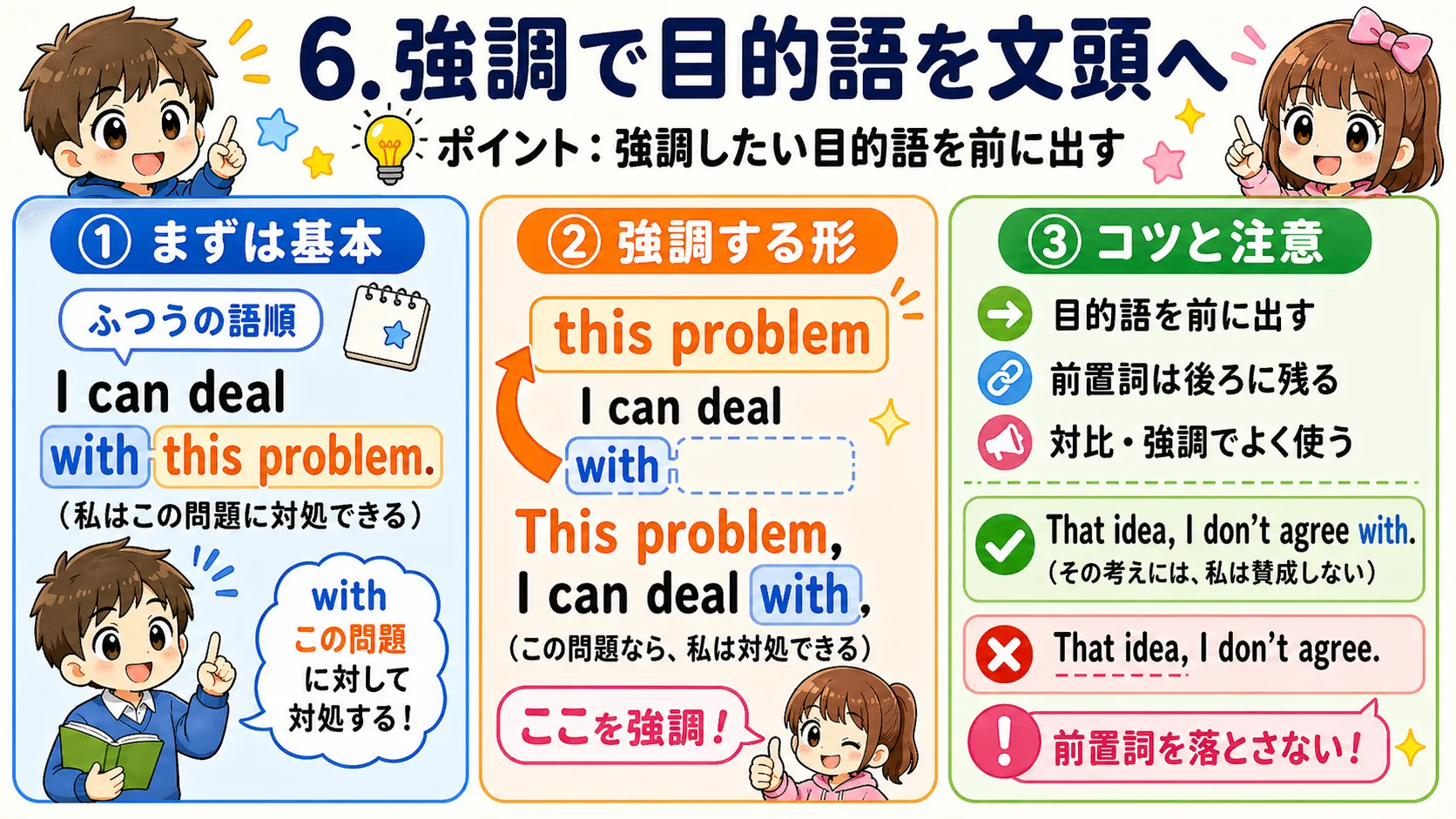
英語では、ふつう
主語 → 動詞 → 目的語
の順に置きます。
ただし、「それについてはね」「その点は特に」と
強調・対比
したいとき、目的語を文頭へ出すことがあります😊
前置詞の目的語を前に出した場合は、
前置詞が文末に残る
のが大事です。
talk about this issue
→
This issue, we need to talk about.
✅
This issue, we need to talk about.❌
This issue, we need to talk.もとの形が
talk about this issue なので、about が必要です。
This topic, we should focus on.
は、ただ「この話題に集中すべき」ではなく、
この話題こそ、集中すべきだ
という強調の感じが出ます。
もとの形が
depend on this data
なら、強調形は
This data, we depend on.
です。
on を落とすと、depend の意味が完成しません。
ふつうは
We need to talk about this issue.
のような語順で十分です。
文頭へ出す形は、
対比・強調・話題の切り替え
をしたいときに使うと自然です。
⚠️ よくあるミス(強調しても前置詞は残す!)
This plan, we agreed.✅ This plan, we agreed on.
agree on a plan なので on が必要です。
We talked about the budget.✅ 強調:
The budget, we talked about.強調したい理由がないなら、通常語順のほうが自然です。
This report, I read yesterday.✅
This topic, I talked about yesterday.read は前置詞なし、talk about は about が必要です。
📌 強調で目的語を文頭へ出すパターンまとめ
| 分類 | 代表語・代表表現(日本語訳) | 通常語順 | 強調語順・ポイント |
|---|---|---|---|
話題about / on / over
|
talk about(〜について話す)comment on(〜についてコメントする)argue over(〜をめぐって議論する)focus on(〜に集中する)write about(〜について書く)complain about(〜について不満を言う)
|
We talked about this issue.They argued over the schedule.
|
This issue, we talked about.The schedule, they argued over.話題を先に出す |
相手to / with / from
|
talk to(〜に話しかける)work with(〜と働く)borrow from(〜から借りる)write to(〜に手紙を書く)learn from(〜から学ぶ)negotiate with(〜と交渉する)
|
I learned a lot from that mentor.We worked with that designer.
|
That mentor, I learned a lot from.That designer, we worked with.人を強調 |
場所in / into / through / around
|
go into(〜に入る)walk through(〜を通り抜ける)sit in(〜に座る/入る)look around(〜を見て回る)stay at(〜に滞在する)pass through(〜を通過する)
|
We never go into that room.They walked through the old tunnel.
|
That room, we never go into.The old tunnel, they walked through.場所を前面に出す |
感情・評価of / about / for
|
be proud of(〜を誇りに思う)be afraid of(〜を恐れる)worry about(〜を心配する)care about(〜を大切に思う)be known for(〜で知られている)be responsible for(〜に責任がある)
|
We are proud of this result.I don't worry about small mistakes.
|
This result, we are proud of.Small mistakes, I don't worry about.気持ちの対象を強調 |
対応・処理with / into / after
|
deal with(〜に対処する)look into(〜を調べる)take care of(〜の世話をする)put up with(〜を我慢する)follow up on(〜を追跡確認する)keep up with(〜についていく)
|
We can deal with this problem.I can't put up with this noise.
|
This problem, we can deal with.This noise, I can't put up with.対応対象を強調 |
否定・対比not / never と相性◎
|
agree with(〜に賛成する)stand for(〜を許す/支持する)depend on(〜に頼る)believe in(〜を信じる)object to(〜に反対する)settle for(〜で妥協する)
|
I don't agree with that idea.We won't settle for that answer.
|
That idea, I don't agree with.That answer, we won't settle for.強い対比 |
about / on / over
talk about(〜について話す)comment on(〜についてコメントする)argue over(〜をめぐって議論する)focus on(〜に集中する)
This issue, we talked about.📌 話題を先に出して強調します。
to / with / from
talk to(〜に話しかける)work with(〜と働く)learn from(〜から学ぶ)negotiate with(〜と交渉する)
That mentor, I learned a lot from.📌 人を強調したいときに使えます。
in / into / through
go into(〜に入る)walk through(〜を通り抜ける)stay at(〜に滞在する)pass through(〜を通過する)
That room, we never go into.📌 場所を話題の中心にします。
of / about / for
be proud of(〜を誇りに思う)worry about(〜を心配する)care about(〜を大切に思う)be responsible for(〜に責任がある)
This result, we are proud of.📌 気持ちの対象を前に出します。
with / into / after
deal with(〜に対処する)look into(〜を調べる)take care of(〜の世話をする)put up with(〜を我慢する)
This problem, we can deal with.📌 対応対象を強調します。
not / never と相性◎
agree with(〜に賛成する)stand for(〜を許す/支持する)depend on(〜に頼る)settle for(〜で妥協する)
That idea, I don't agree with.📌 「それは違う」という対比が強く出ます。
💬 例文で感覚をつかもう!(強調で目的語を文頭へ)
This issue, we need to talk about before lunch.
(この問題については、昼食前に話し合う必要があります。)
🔧 もとの形は talk about this issue です。
✅ This issue を文頭へ出すことで、「この問題は特に」という強調になります。
⚠️ about を落とすと、talk の対象がなくなって意味が足りません。
That coach, I learned a lot from.
(あのコーチからは、私は多くを学びました。)
🔧 もとの形は learn a lot from that coach です。
✅ That coach を前に出すことで、「ほかの人ではなく、あのコーチから」という印象が強まります。
💡 対比の気持ちがあるときに自然です。
That idea, I don't agree with.
(その考えには、私は賛成できません。)
🔧 もとの形は agree with that idea です。
✅ 文頭に出すことで、「その考えに関しては」という対比がはっきりします。
⚠️ 否定文と組み合わせると、かなり強い印象になることがあります。
That storage room, we never go into.
(あの倉庫部屋には、私たちは絶対に入りません。)
🔧 もとの形は go into that storage room です。
✅ That storage room を先に出して、「あの部屋は特別に」という雰囲気を作っています。
📌 never と組み合わせると、強い禁止・注意の感じが出ます。
This result, our whole team is proud of.
(この結果については、チーム全員が誇りに思っています。)
🔧 もとの形は be proud of this result です。
✅ This result を文頭に置くことで、結果そのものにスポットライトが当たります。
💡 発表・振り返り・成果報告で使いやすい表現です。
This problem, we can deal with after the meeting.
(この問題については、会議の後で対応できます。)
🔧 もとの形は deal with this problem です。
✅ 文頭に出すことで、「この問題はあとで対応できる」という整理・優先順位づけの感じが出ます。
📌 deal with は仕事・相談・トラブル対応でよく使います。
Pronunciation, beginners should focus on early.
(発音については、初心者は早めに集中すべきです。)
🔧 もとの形は focus on pronunciation です。
✅ Pronunciation を前に出すことで、「発音は特に」という学習アドバイスの感じになります。
⚠️ focus はこの意味では on とセットで使います。
That kind of behavior, we will not stand for.
(そのような行動は、私たちは許しません。)
🔧 stand for ... はここでは「〜を許す/容認する」という意味です。
✅ 文頭に出した That kind of behavior が、強く拒否したい対象です。
📌 かなり強い言い方なので、注意・ルール説明などで使われやすいです。
That supplier, we should negotiate with carefully.
(その仕入れ先とは、慎重に交渉すべきです。)
🔧 もとの形は negotiate with that supplier です。
✅ That supplier を前に出すことで、「その仕入れ先については特に」という注意のニュアンスが出ます。
💡 carefully を添えると、慎重さを強調できます。
- ✅ 強調・対比したい目的語は、文頭に出せることがある。
- ✅ 前置詞の目的語を前に出しても、前置詞は文末に残す。
- ✅
This issue, we need to talk about.のように、話題を先に出してから説明する。 - ⚠️ ふつうの文では通常語順でOK。文頭へ出す形は、強調したい理由があるときに使う。
This issue, we need to talk about. のように、
強調したい目的語を文頭へ出しても、必要な前置詞を最後に残せるかな?
「前に出すのは目的語、前置詞は文末に残す」という感覚をクイズで確認してみよう 😊
総まとめ:前置詞の位置と前置詞残りの使い分け
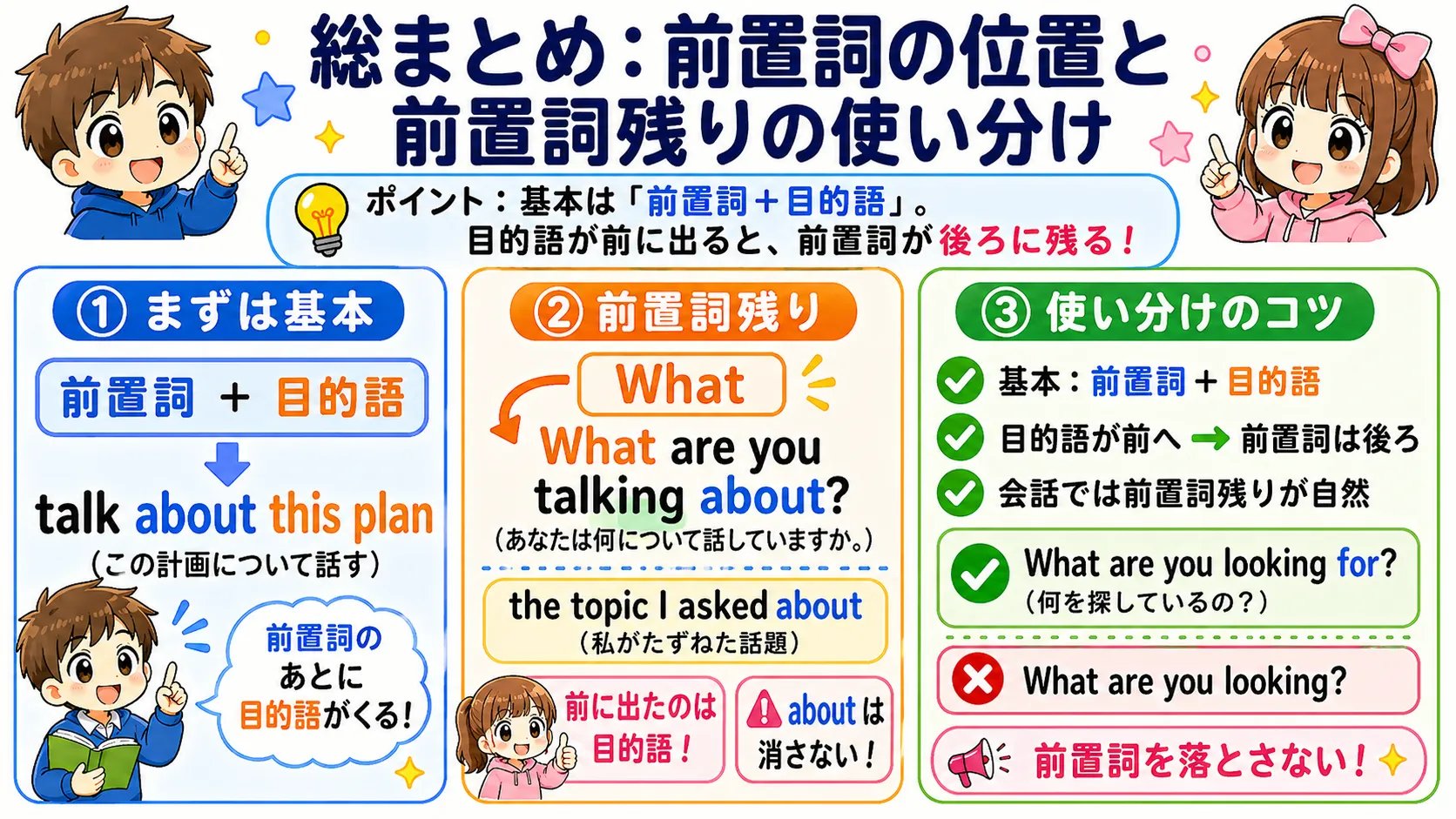
前置詞は、基本的には
前置詞 + 名詞・代名詞
の形で使います。
ただし、疑問詞・関係代名詞・to不定詞・受動態・強調などが関わると、
前置詞の目的語が前へ移動
し、前置詞だけが後ろに残ることがあります😊
この総まとめでは、
「前置詞を前に置く形」と「前置詞が後ろに残る形」
を一気に整理します。
✅
Who are you waiting for?✅
the topic we talked about✅
a chair to sit on前に出た語だけ見ず、もとの動詞表現まで確認するのがコツです。
基本は
in the room
/
with her
/
after dinner
のように、前置詞の後ろに名詞・代名詞・動名詞・名詞節を置きます。
look for what の what が前へ出ると、
What are you looking for?
になります。
前置詞を消さない
のが最大のポイントです。
会話では
the person I spoke to
が自然です。
書き言葉では
the person to whom I spoke
のように、前置詞を前に出す形もあります。
ただし、前置詞の直後に that は置けません。
⚠️ 総まとめのミス防止チェック
What are you looking?✅ What are you looking for?
look for で「〜を探す」です。
between you and I✅ between you and me
前置詞の後ろは目的格が基本です。
that を使う
the topic about that we talked✅ the topic about which we talked
前置詞の直後は
which / whom。
疑問詞・関係代名詞・to不定詞・受動態・強調のどれでも、この考え方が土台になります。
📌 前置詞の位置・前置詞残り 総整理表
| 分類 | 代表語・代表表現(日本語訳) | よく使う形 | 判断ポイント |
|---|---|---|---|
基本位置前置詞 + 目的語
|
in the office(オフィスで)at the counter(カウンターで)on the screen(画面上に)with my team(私のチームと)before the deadline(締切前に)after the call(電話の後で)
|
前置詞 + 名詞前置詞 + 代名詞前置詞 + 動名詞
|
まずは基本形。 前置詞の後ろに「名詞の仲間」が来ているか確認します。 |
疑問詞What ... for?
|
look for(〜を探す)wait for(〜を待つ)talk about(〜について話す)listen to(〜を聞く)work with(〜と働く)come from(〜出身である/〜から来る)
|
What are you waiting for?Who did you work with?Where is she from?
|
疑問詞が前に出ても、前置詞は残します。 会話ではとても自然な形です。 |
関係代名詞名詞 + S V 前置詞
|
the person I spoke to(私が話しかけた人)the topic we talked about(私たちが話した話題)the app users rely on(利用者が頼るアプリ)the room they met in(彼らが会った部屋)the customer we replied to(私たちが返信したお客様)
|
the person who I spoke tothe topic that we talked aboutthe room they met in
|
目的語の関係代名詞は省略されることも多いです。 ただし、前置詞は文末に残します。 |
フォーマル前置詞 + whom/which
|
to whom(誰に)with whom(誰と)for whom(誰のために)about which(どれについて)in which(その中で)on which(その上で/それに基づいて)
|
the person to whom I wrotethe rule on which we dependthe room in which they met
|
書き言葉・かたい文で使います。 前置詞の直後に that や省略は使えません。
|
to不定詞名詞 + to V + 前置詞
|
a chair to sit on(座る椅子)a pen to write with(書くためのペン)a room to study in(勉強する部屋)someone to talk to(話し相手)a topic to think about(考える話題)money to live on(生活するためのお金)
|
a chair to sit ona tool to open it withsomething to be proud of
|
もとの形に前置詞があるかを確認します。sit on a chair なら on が残ります。
|
群動詞の受動態be + 過去分詞 + 前置詞/副詞
|
look after(世話をする)deal with(対処する)talk about(〜について話す)laugh at(〜を笑う)turn down(断る/却下する)put up with(我慢する)
|
The child was looked after.The issue was dealt with.The offer was turned down.
|
群動詞は受動態でもセットを崩しません。 目的語を取る群動詞だけ受動態にできます。 |
強調目的語, S V 前置詞
|
agree with(〜に賛成する)focus on(〜に集中する)depend on(〜に頼る)be proud of(〜を誇りに思う)deal with(〜に対処する)stand for(〜を許す/支持する)
|
That idea, I don't agree with.This result, we are proud of.This problem, we can deal with.
|
強調・対比の形です。 通常語順で十分な場面では、無理に使わなくてOKです。 |
最終判断もとの形を見る
|
read a book(本を読む)sit on a chair(椅子に座る)listen to music(音楽を聞く)talk about plans(計画について話す)be afraid of dogs(犬を怖がる)depend on data(データに頼る)
|
a book to reada chair to sit onWhat are you listening to?
|
迷ったら、もとの動詞表現に戻します。 そこに前置詞があるなら、前置詞残りが起きやすいです。 |
in the office(オフィスで)with my team(私のチームと)after the call(電話の後で)📌 前置詞の後ろには名詞の仲間が来ます。
look for(〜を探す)wait for(〜を待つ)listen to(〜を聞く)✅
What are you looking for?
the person I spoke to(私が話しかけた人)the topic we talked about(私たちが話した話題)the app users rely on(利用者が頼るアプリ)📌 会話では文末に前置詞を残す形が自然です。
to whom(誰に)about which(どれについて)in which(その中で)⚠️ 前置詞の直後に
that は置けません。
a chair to sit on(座る椅子)a pen to write with(書くためのペン)someone to talk to(話し相手)📌 もとの形に前置詞があるかを見ます。
look after(世話をする)deal with(対処する)turn down(断る/却下する)✅
The issue was dealt with.
agree with(〜に賛成する)focus on(〜に集中する)be proud of(〜を誇りに思う)✅
That idea, I don't agree with.
read a book(本を読む)→ a book to readsit on a chair(椅子に座る)→ a chair to sit onlisten to music(音楽を聞く)→ What are you listening to?📌 迷ったら、もとの動詞表現に戻します。
💬 例文で総復習しよう!(前置詞の位置と前置詞残り)
Please share the notes with the new members.
(そのメモを新しいメンバーと共有してください。)
🔧 with the new members は「新しいメンバーと」。前置詞 with の後ろに名詞句が来ています。
✅ これは前置詞の基本位置です。前置詞の後ろに目的語がそのまま残っています。
💡 share A with B は「AをBと共有する」の実用表現です。
Who are we waiting for?
(私たちは誰を待っているのですか。)
🔧 もとの形は wait for someone です。
✅ someone が who になって文頭へ出たため、for が文末に残っています。
⚠️ Who are we waiting? では for が足りません。
This is the checklist that our team relies on.
(これが、私たちのチームが頼りにしているチェックリストです。)
🔧 もとの形は our team relies on the checklist です。
✅ 先行詞 the checklist が前に出ているため、on が文末に残ります。
💡 この that は目的語なので、This is the checklist our team relies on. と省略もできます。
This is the purpose for which the fund was created.
(これが、その基金が設立された目的です。)
🔧 for which は「その目的のために」というフォーマルな関係代名詞表現です。
✅ 前置詞を前に出しているため、which を使っています。
⚠️ for that とはしません。前置詞の直後は which が基本です。
Do we have a spare pen to write with?
(書くための予備のペンはありますか。)
🔧 もとの形は write with a pen です。
✅ a spare pen が前に出て名詞として説明され、with が文末に残っています。
📌 道具を表すときは with を忘れやすいので注意です。
The billing error has been looked into by the support team.
(その請求エラーは、サポートチームによって調査されました。)
🔧 能動態は The support team looked into the billing error. です。
✅ 受動態になっても、群動詞 look into はセットで残ります。
⚠️ has been looked だけでは「調査された」の意味になりません。
This data, we can depend on.
(このデータについては、私たちは信頼できます。)
🔧 もとの形は depend on this data です。
✅ This data を文頭に出して強調し、on は文末に残しています。
💡 「他のデータは不安だけど、このデータは信頼できる」のような対比に向いています。
I have several emails to answer before noon.
(正午までに返信するメールがいくつかあります。)
🔧 answer emails は、前置詞なしで目的語を取れます。
✅ そのため、emails to answer でOKです。
⚠️ emails to answer to のように不要な前置詞を足さないようにします。
What are your students interested in these days?
(最近、あなたの生徒たちは何に興味がありますか。)
🔧 もとの形は be interested in something です。
✅ something が what になって前に出たので、in が文末に残ります。
📌 形容詞+前置詞のセットも、前置詞残りの対象になります。
- ✅ 基本は
前置詞 + 名詞・代名詞・動名詞・名詞節。 - ✅ 疑問詞・関係代名詞・to不定詞・受動態・強調では、前置詞の目的語が前へ出ることがある。
- ✅ 目的語が前へ出ても、前置詞は消さずに文末へ残す。
- ✅ フォーマル形では
前置詞 + whom / whichを使う。 - ⚠️ 迷ったら、もとの動詞表現 に戻して、前置詞が必要か確認する。
What are you looking for?、
the chair to sit on、
This issue, we need to talk about. のように、
「もとの表現で必要な前置詞を落とさない」感覚が身についているかクイズでチェック!
🔁 次におすすめのレッスン
Lesson087「前置詞の位置」で学んだ 前置詞の置き場所 を、次は「前置詞句」「時・場所・個別前置詞」へ広げていきましょう😊